
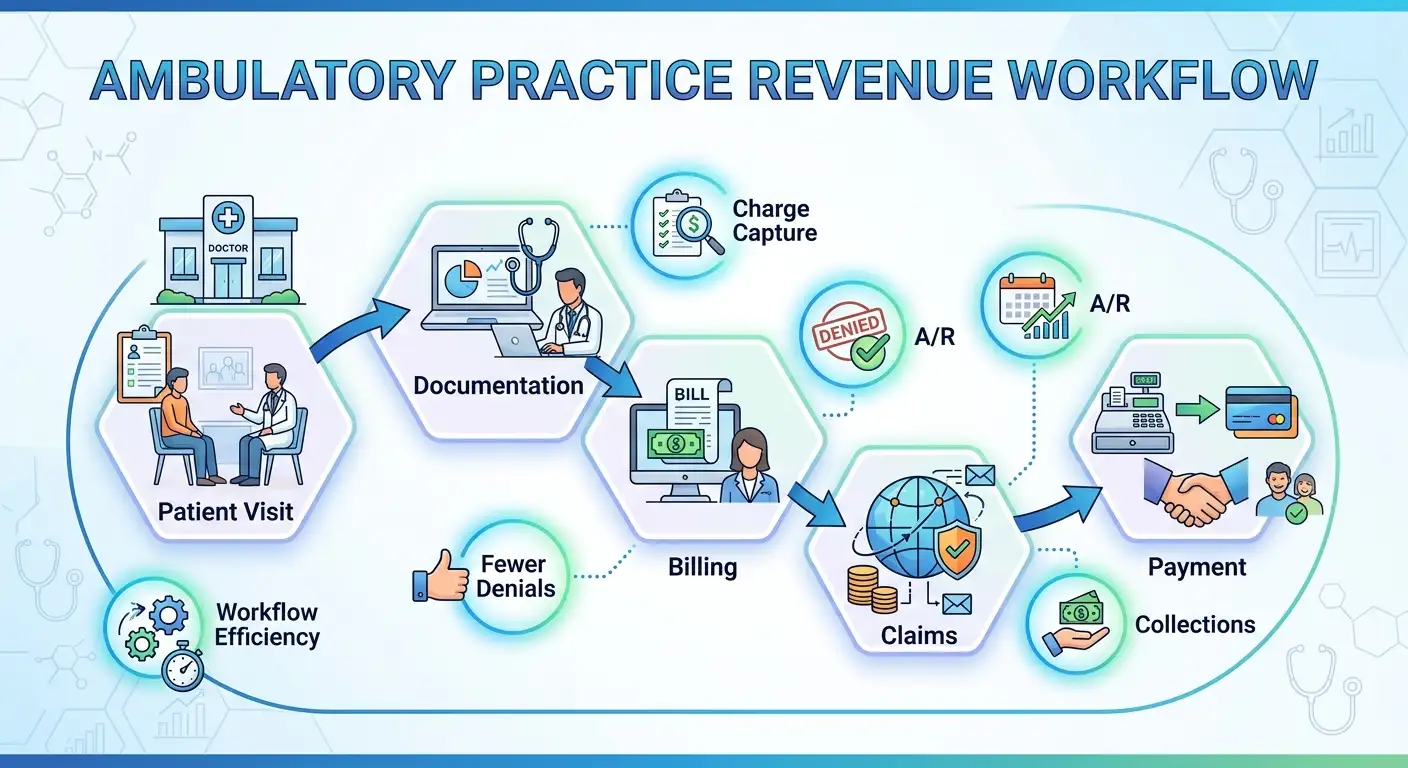

Medical billing reports can reveal far more than how much a practice collected last month. They can uncover delayed billing, unresolved balances, payer issues, and workflow problems that may quietly affect revenue.
Yet many ambulatory practices focus primarily on familiar reports, such as A/R aging and collections. Meanwhile, other reports that can reveal less obvious revenue gaps may go largely unused.
That creates blind spots. A practice can have strong overall collections while still losing revenue through unbilled encounters, payer denials, unnecessary adjustments, or missed appointments.
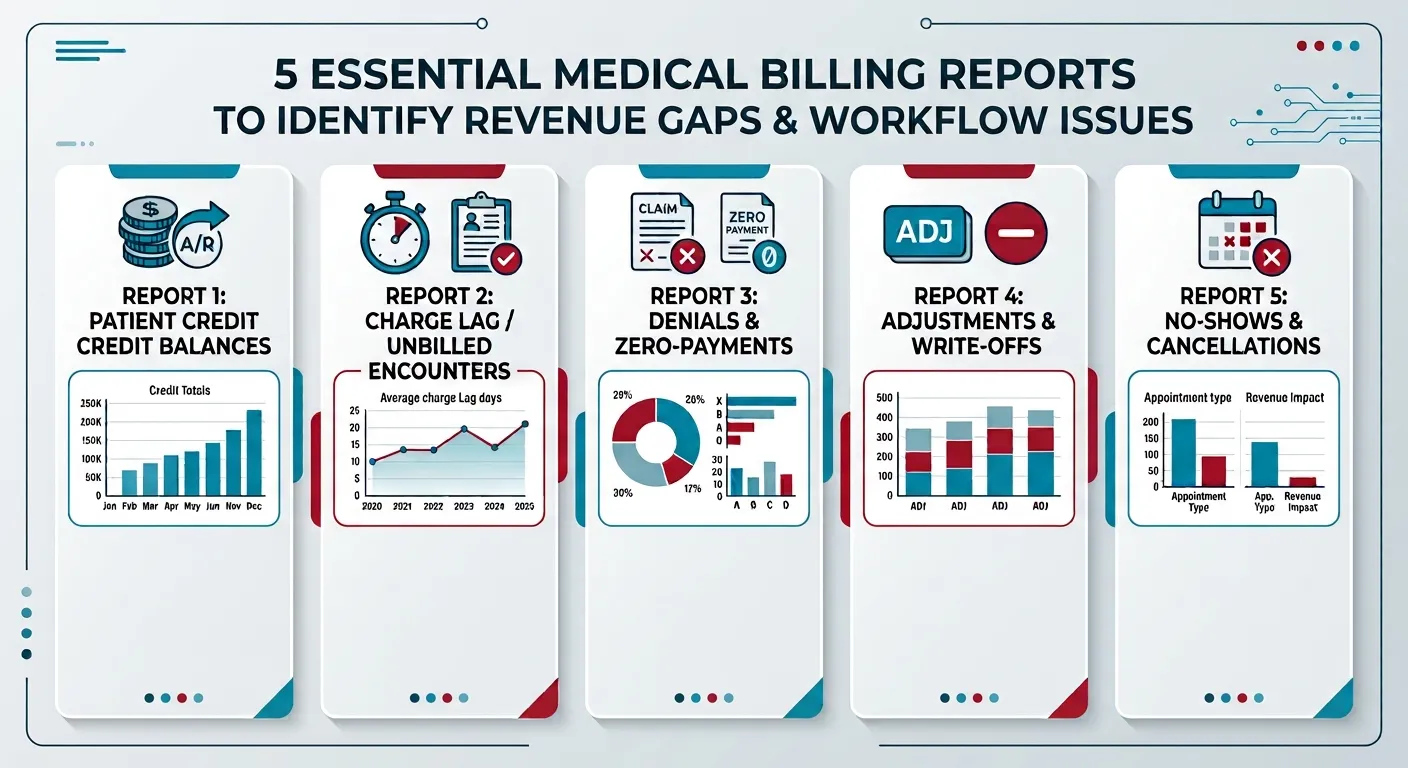
The key is knowing which reports to review and what they can reveal. Here are five medical billing reports every physician practice should consider reviewing more consistently.
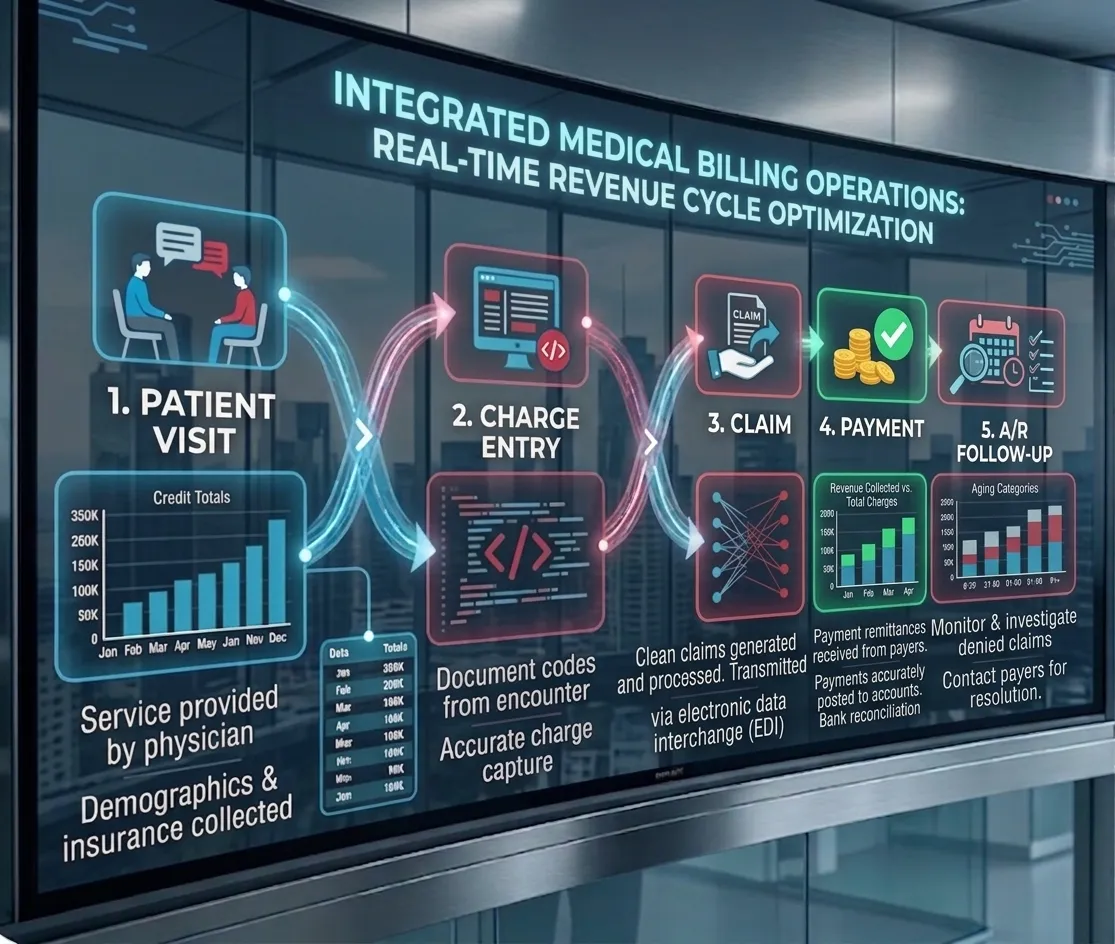
Each step in the revenue cycle can reveal opportunities to improve billing performance, reduce delays, and identify potential revenue gaps.
Which Medical Billing Reports Should Physician Practices Review?
The most useful reports connect financial results with the workflows that produce them. Rather than simply looking at totals, practice leaders should look for trends, exceptions, and recurring problems.
-
Patient Credit Balance Report: Is Money Sitting on Patient Accounts?
A patient credit balance report identifies accounts where payments exceed the amount currently owed. The balance may result from an overpayment, duplicate payment, insurance adjustment, or payment that has not been properly allocated.
These balances deserve regular attention because they may represent money that needs to be refunded or correctly applied.
For example, a recurring credit balance could point to payment-posting issues or inconsistent workflows between insurance and patient payments.
What to look for:
- Aging credit balances
- Large or unusual credits
- Repeated credits involving the same payer or workflow
- Credits that have not been resolved promptly
The AMA also provides resources addressing overpayment recovery and proper claims payment, reinforcing the importance of reviewing payment issues rather than allowing them to remain unresolved.
-
Charge Lag or Unbilled Encounters Report: Are Services Being Billed Promptly?
Charge lag measures the time between when care occurs and when charges are entered or billed.
A growing lag can indicate incomplete documentation, coding delays, unposted charges, or workflow bottlenecks between clinical and billing teams.
In turn, delayed billing can delay reimbursement.
The AMA identifies charge lag time and missed charges as useful revenue cycle performance indicators.
Practice leaders should ask:
- How many encounters remain unbilled?
- How old are the oldest unbilled encounters?
- Are delays concentrated among specific providers or departments?
- Is documentation holding up billing?
This report can be particularly valuable because it identifies problems before they become aging A/R.
-
Payer Denial and Zero-Payment Analysis: Where Is Revenue Being Lost?
A denial report shows which claims were rejected or denied and why. A zero-payment report can go a step further by identifying claims that were processed without reimbursement.
Together, these reports can reveal payer-specific revenue leakage.
For instance, a pattern involving one payer could indicate changing requirements, coding issues, authorization problems, or contract-related payment concerns.
CMS publishes standardized denial reason information for Medicare claims, demonstrating why understanding denial reasons matters when evaluating payment decisions.
Look for trends by:
- Payer
- Denial reason
- Provider
- Procedure or service
- Dollar amount
- Frequency of occurrence
Most importantly, do not stop at the denial count. Ask why the denials are happening and whether the underlying issue can be prevented.
-
Adjustment and Write-Off Analysis: Where Is Revenue Being Reduced?
Adjustments are a normal part of medical billing. However, unexplained or frequently recurring adjustments deserve closer review.
An adjustment and write-off report can show where expected revenue is being reduced and whether those reductions are consistent with payer contracts, patient financial policies, or established practice procedures.
For example, unusual write-offs could point to incorrect posting, inconsistent collection practices, or payments that do not align with expectations.
Review for:
- Large write-offs
- Recurring adjustments
- Unexpected payer variances
- Provider or department patterns
- Adjustments without clear explanations
Regular review can help distinguish appropriate contractual adjustments from potential revenue leakage.
-
No-Show and Cancellation Financial Impact Report: What Is Missed Care Costing the Practice?
No-show reports are usually viewed as scheduling tools. They can also provide valuable financial insight.
Every missed appointment can affect more than the schedule. It may also represent lost billable time, unused clinical capacity, and additional administrative work.
Therefore, practice leaders should consider connecting appointment data with financial information.
Look at no-shows and cancellations by provider, appointment type, location, and patient segment. Then compare those patterns with the revenue associated with the affected visits.
This can help answer a practical question: Where are missed appointments creating the greatest financial and operational impact?
It may also identify opportunities for better reminders, waitlist management, scheduling workflows, or patient outreach.
How Often Should Practices Review Medical Billing Reports?
Not every report needs to be reviewed every day. The key is establishing a consistent reporting rhythm based on the risk and purpose of each report.
A practical starting point might look like this:
- Weekly: Charge lag, unbilled encounters, denials, and zero-payment claims
- Monthly: Patient credit balances and adjustment/write-off trends
- Monthly: No-show and cancellation patterns
- Quarterly: Compare trends across providers, payers, locations, and service lines
The exact schedule should reflect the size and complexity of the practice. More importantly, someone should be responsible for reviewing the reports and documenting follow-up.
Technology can make this process considerably easier. Modern practice management systems can generate financial reports and automate portions of revenue cycle workflows.
For additional guidance, the AMA’s revenue cycle management resources for physician practices provide practical information on claims, payments, denials, and revenue cycle processes.
What Should Ambulatory Practices Do Next?
Medical billing reports are most valuable when they lead to action. Instead of simply reviewing numbers, practice leaders should establish a repeatable process for identifying issues and assigning follow-up.
Start by:
- Choose five core reports that align with your practice’s financial and operational priorities.
- Assign ownership for reviewing each report and addressing exceptions.
- Track trends over time rather than evaluating individual reports in isolation.
- Look for root causes, not just the financial impact.
- Connect billing data with clinical and front-office workflows when a recurring issue is identified.
- Use technology and automation where manual reporting consumes unnecessary staff time.
VOWHS also explores practical strategies for improving revenue cycle performance in Beyond Claims: How Practice Managers Can Strengthen Revenue Cycle Operations, including how billing, clinical, scheduling, and administrative workflows can work together more effectively.
For practices looking more closely at outstanding balances, 5 Proven Steps to Reduce A/R and Improve Medical Practice Collections provides additional guidance on identifying and addressing A/R challenges.
Better Reporting Can Lead to Better Revenue Cycle Decisions
Medical billing reports should not be viewed as paperwork for the billing department. They are management tools that can help physician practices understand what is working, where revenue is being delayed, and which workflows need attention.
The goal is not to run more reports. It is to use the right reports consistently and turn what they reveal into practical improvements.