

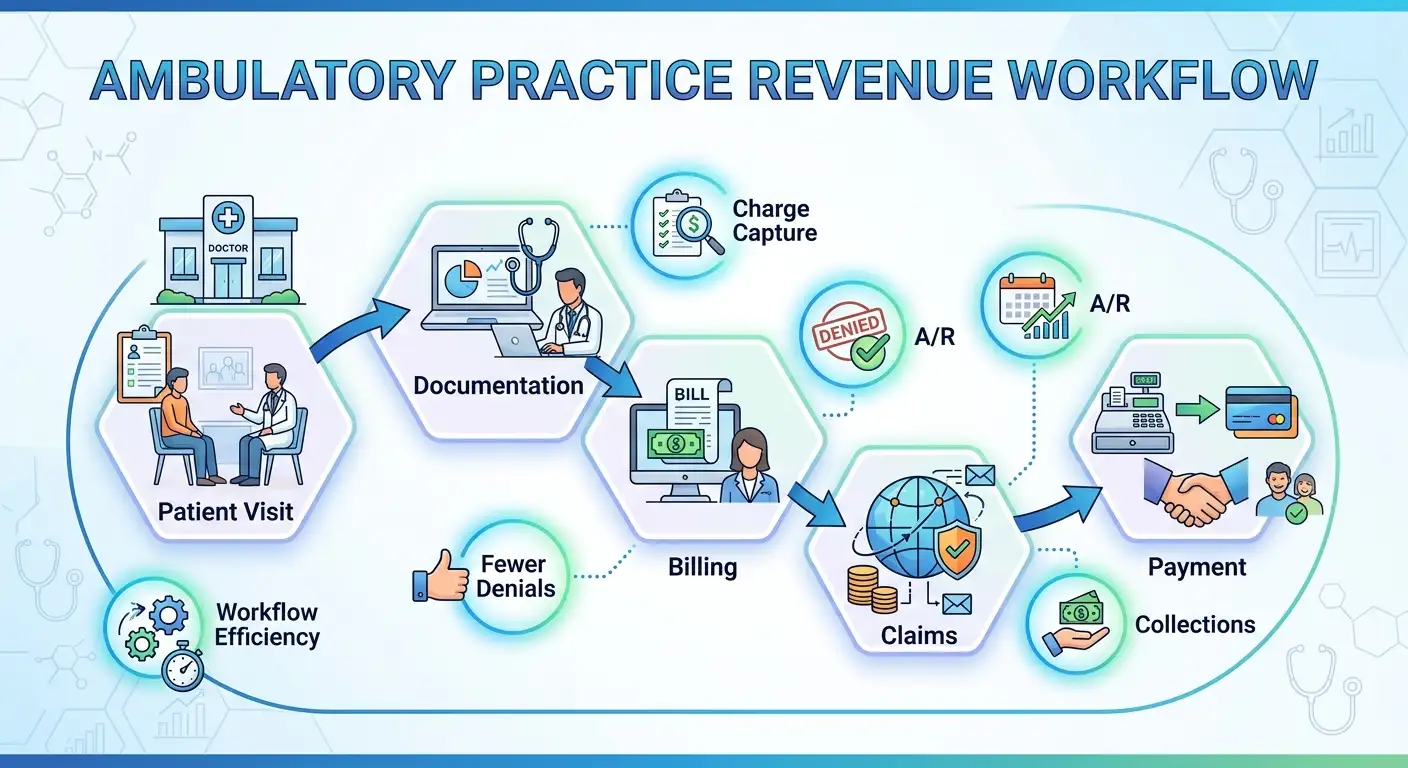
For many ambulatory practices, increasing revenue does not necessarily mean seeing more patients.
When schedules are already full, adding more visits can put additional pressure on physicians and staff. Meanwhile, revenue may already be slipping through delayed charges, denials, aging A/R, missed appointments, or inefficient workflows.
As a result, medical practice revenue growth should not be measured by patient volume alone. Before adding more patients, practice leaders should look at how effectively the practice captures, collects, and retains revenue from the care it already provides.
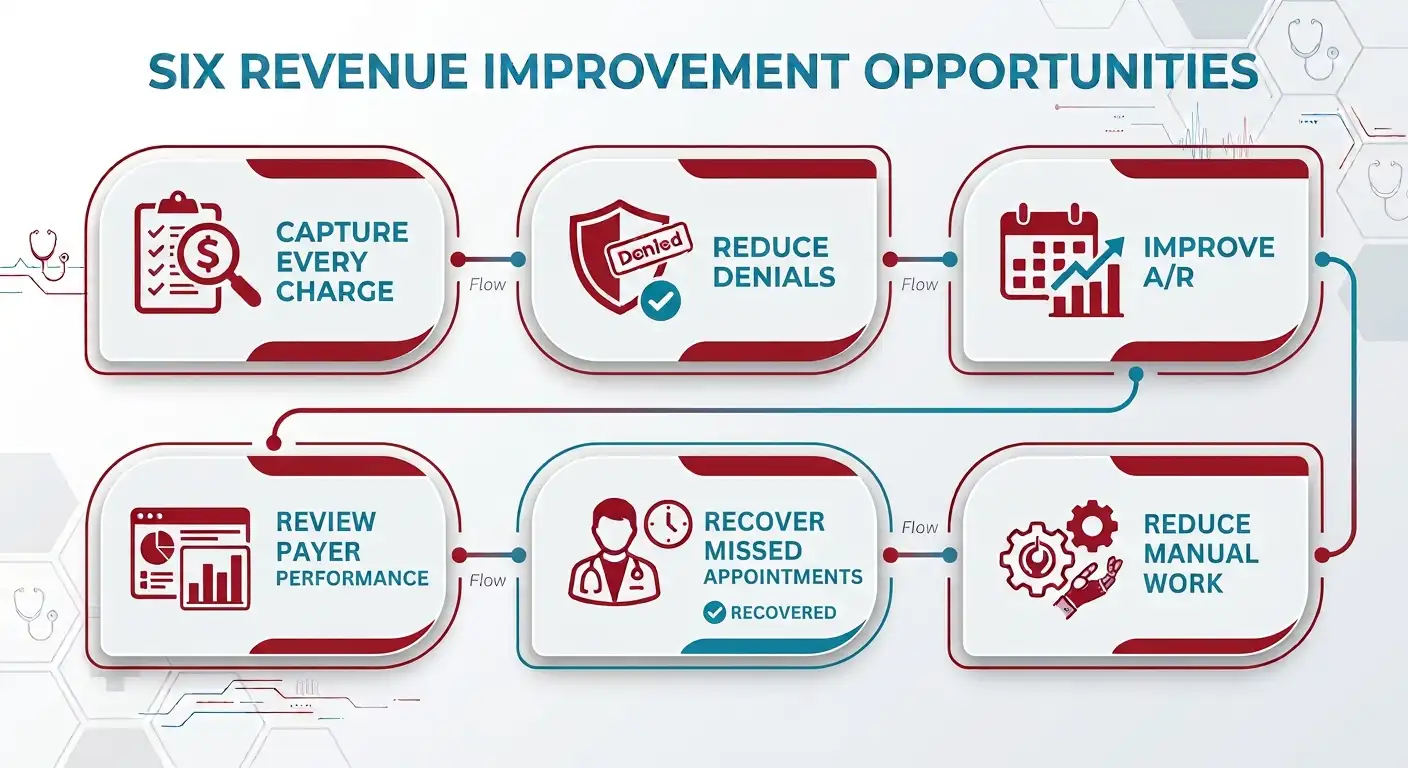
Here are six areas worth examining.
Where Can a Medical Practice Find Revenue Without Adding Patient Volume?
The biggest opportunities are often found within existing financial and operational processes.
1. Capture Every Billable Service and Charge
A completed visit does not automatically mean every appropriate service has been captured and billed correctly.
For example, delayed charge entry, incomplete documentation, missed charges, or communication gaps between clinical and billing teams can create revenue leakage.
Practice leaders should regularly review:
- Unbilled encounters and charge lag
- Services documented but not billed
- Missing or delayed documentation
- Recurring workflow breakdowns by provider or department
A consistent process for identifying and resolving these issues can help improve the medical practice revenue cycle without increasing appointment volume.
For a practical starting point, Virtual OfficeWare Healthcare Solutions’ (VOWHS’) article on 5 medical billing reports every physician practice should review highlights several reports that can help reveal potential revenue gaps.
2. Reduce Preventable Denials
A denial is more than a billing problem. Repeated denials can consume staff time, delay payment, and create unnecessary rework.
Rather than simply tracking how many claims are denied, look for patterns. Are denials concentrated around specific payers, procedures, providers, authorization requirements, or documentation issues?
The American Medical Association’s (AMA’s) research on prior authorization highlights the administrative and workflow burden these processes can create for physician practices.
3. Improve A/R and Get Paid Faster
Revenue that remains in accounts receivable does not help today’s cash flow.
Meanwhile, regularly reviewing aging A/R helps practices identify unresolved claims, follow up on outstanding balances, and improve cash flow.
The goal is not simply to collect more aggressively. It is to understand why money is not being collected promptly and address the process creating the delay.
Better visibility into A/R can support stronger cash flow and more predictable medical practice financial performance.
4. Look More Closely at Payer Performance
Not every payer affects your practice in the same way.
By comparing reimbursement rates, denial patterns, payment timing, and administrative effort, practices can identify which payer relationships may need closer attention.
Practice leaders should compare payer performance and ask:
- Which payers generate the most rework?
- Where are payments consistently delayed?
- Are expected reimbursements being received?
- Are contractual adjustments and write-offs reasonable?
- Which payer-related workflows require the most staff time?
This type of analysis can uncover revenue opportunities for medical practices that are difficult to see when financial results are viewed only as a single monthly total.
Centers for Medicare & Medicaid Services (CMS) continues to update Medicare payment policies and physician fee schedules, making it important for practices to stay aware of reimbursement changes that may affect financial planning.
5. Recover Revenue From Missed Appointments
A cancellation or no-show does not have to become a completely lost opportunity.
To address this, practices can examine when cancellations occur, which appointment types are most affected, and whether available openings can be filled through waitlists, reminders, or targeted patient outreach.
The objective is not to pressure patients into additional visits. Instead, it is to make better use of clinical capacity that is already available.
Connecting scheduling, patient communication, and financial data can also help reveal whether missed appointments are creating a meaningful impact on practice performance.
6. Reduce Manual Work That Slows Revenue
Medical practice revenue growth can also come from giving staff more time to focus on work that requires their attention.
Manual data entry, repetitive claim follow-up, duplicate documentation, disconnected systems, and unnecessary handoffs can slow the medical practice workflow and increase administrative work.
The U.S. Department of Health and Human Resources (HHS’s) Administrative Simplification standards were established in part to reduce paperwork and streamline healthcare business processes.
The present opportunity is to look for workflows that can be simplified, connected, or automated without sacrificing oversight.
For example, better integration between scheduling, clinical documentation, billing, reporting, and patient communication can reduce the number of times staff have to manually move information from one process to another.
Medical practice revenue growth is not always about doing more. Sometimes, it means capturing more of what your practice is already earning, reducing avoidable losses, and making existing workflows work better.

What Should Ambulatory Practices Do Next?
Growing practice revenue without adding patients starts with understanding where existing revenue is being delayed, reduced, or missed.
Practice leaders should consider:
- Review unbilled encounters, denials, A/R, adjustments, and write-offs regularly.
- Identify recurring revenue-cycle problems rather than addressing each issue individually.
- Compare payer performance and reimbursement patterns.
- Connect scheduling and financial data to understand the cost of missed capacity.
- Look for manual workflows that create unnecessary staff work or billing delays.
- Use practice data to identify trends before they become larger financial problems.
VOWHS’ resource on healthcare data analytics for medical practices explores how connecting financial, operational, scheduling, and workflow data can help practice leaders make better decisions.