


For many ambulatory practices, revenue challenges do not begin when a claim is denied. They often start much earlier—with disconnected workflows, incomplete documentation, inefficient processes, and limited visibility into where revenue is being delayed or lost.
As reimbursement pressures increase and administrative demands continue to grow, practice managers and healthcare leaders need to look beyond claims submission. A strong Revenue Cycle Management (RCM) strategy requires coordination across scheduling, patient access, clinical documentation, coding, billing, and payment follow-up.
The goal is not simply to submit more claims. It is to create a more predictable financial operation that helps protect earned revenue while allowing providers and staff to focus on delivering quality patient care.
Why Is Revenue Cycle Management More Than Just Billing?

Revenue Cycle Management includes every step that moves a patient encounter from appointment scheduling to final payment. While billing teams play an important role, many revenue problems originate before a claim ever reaches the payer.
For example, inaccurate patient information, missing authorizations, documentation gaps, coding inconsistencies, or delayed charge capture can create downstream issues that are harder and more costly to resolve.
Strong Revenue Cycle Management requires looking beyond claims submission. The American Medical Association (AMA) has a guide to effective Revenue Cycle Management highlighting the importance of evaluating workflows, monitoring performance, and improving processes across the revenue cycle.
A stronger revenue cycle helps practices:
- Reduce preventable claim delays and denials
- Improve visibility into outstanding accounts receivable
- Identify workflow inefficiencies
- Strengthen communication between clinical and administrative teams
- Create a more consistent patient financial experience
What Operational Areas Should Practice Managers Evaluate?
Start With Front-End Revenue Cycle Workflows
Many practices focus heavily on denied claims, but prevention often starts before the claim is created.
Front-end processes influence whether claims are accurate and complete. Therefore, practice leaders should evaluate areas such as:
- Patient registration accuracy
- Insurance eligibility verification
- Prior authorization workflows
- Appointment scheduling processes
- Provider documentation completion
Small workflow issues can create significant financial impact when they occur repeatedly across hundreds or thousands of patient encounters.
For instance, missing insurance information or incomplete documentation may delay reimbursement, increase staff workload, and create unnecessary follow-up activities.
Improve Visibility Into Billing Performance
A successful Revenue Cycle Management process requires more than submitting claims and waiting for payment. Practice leaders need actionable insight into performance trends.
Key areas to monitor include:
- Claim submission timelines
- Denial reasons and frequency
- Aging accounts receivable
- Unpaid claims requiring follow-up
- Payer-specific payment patterns
Since payer requirements and claim processes continue to evolve, practices should regularly review denial trends and understand available resolution pathways. CMS provides guidance on claim appeals and related processes that can help practices better navigate reimbursement challenges.
Additionally, understanding why claims are delayed or denied allows managers to address root causes rather than repeatedly correcting symptoms.
How Can Technology Improve Revenue Cycle Efficiency?

Use Healthcare Technology to Reduce Manual Work
Modern practice management and EHR solutions can help streamline revenue cycle workflows by improving data accuracy, automating routine tasks, and providing better financial visibility.
Technology can support areas such as:
- Automated claim checks before submission
- Integrated scheduling and billing workflows
- Electronic eligibility verification
- Financial reporting dashboards
- Improved communication between departments
However, technology alone does not solve every revenue challenge. Successful implementation depends on aligning software capabilities with practical workflows and experienced oversight.
A system may identify an issue, but experienced revenue cycle professionals are often needed to interpret trends, correct workflow problems, and develop improvement strategies.
Virtual OfficeWare Healthcare Solutions provides healthcare technology solutions designed to help practices improve operational efficiency, including practice management and EHR platforms that support billing, scheduling, and workflow optimization. CureMD EHR and Practice Management Solutions
Combine Automation With Revenue Cycle Expertise
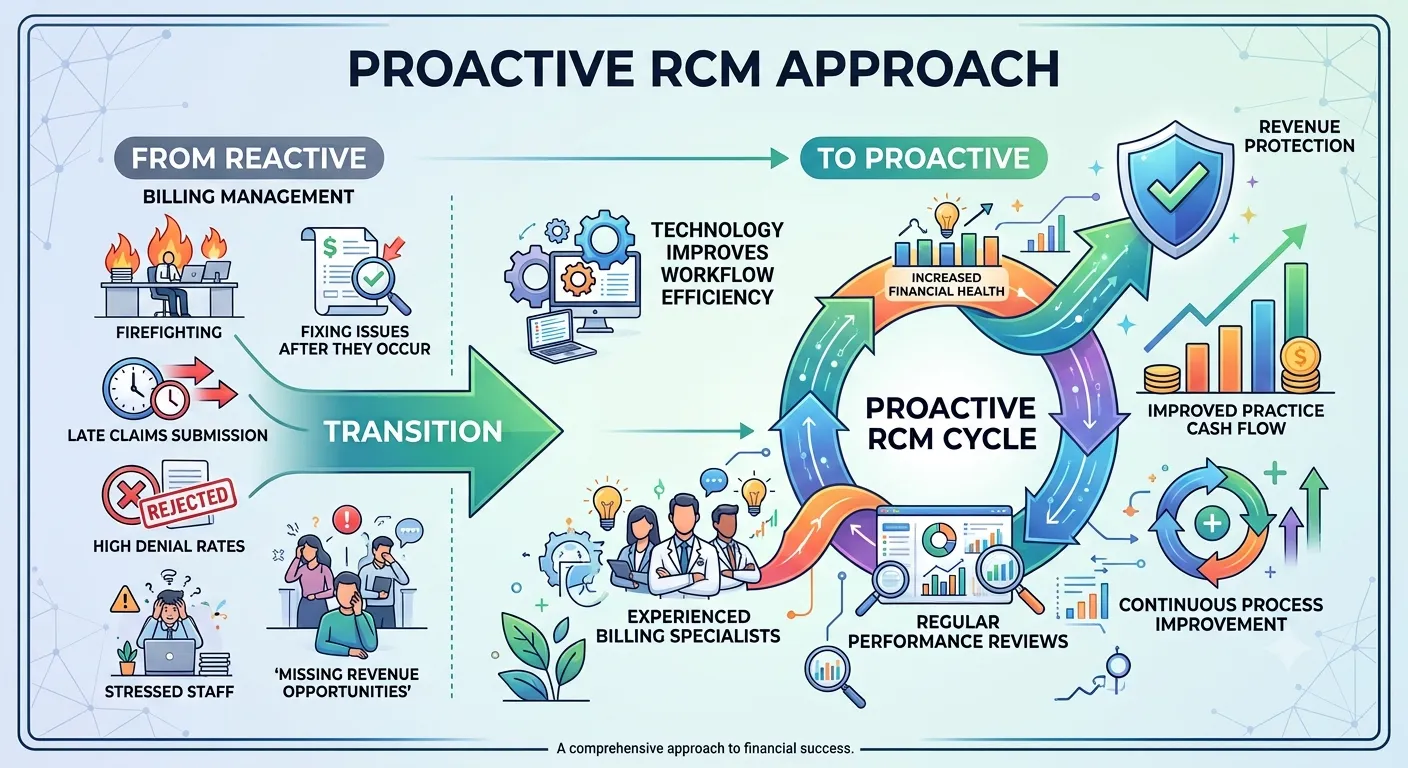
Automation can improve consistency, but human expertise remains critical when managing complex payer requirements, denials, and reimbursement challenges.
A proactive RCM approach combines:
- Technology that improves workflow efficiency
- Experienced billing specialists who identify risks
- Regular performance reviews
- Continuous process improvement
This approach helps practices move from reactive billing management toward proactive revenue protection.
What Should Ambulatory Practices Do Next?
Strengthening your revenue cycle does not require changing everything at once. Instead, practice leaders should focus on the areas creating the greatest operational impact.
Consider these next steps:
- Review your current billing workflow from scheduling through payment collection.
- Identify recurring denial patterns and address the source of the problem.
- Evaluate whether your technology provides enough visibility into revenue performance.
- Measure key financial indicators consistently.
- Determine where additional expertise could improve efficiency and revenue capture.
A well-managed revenue cycle supports more than financial health. It gives practices the stability needed to invest in staff, technology, and better patient care.