
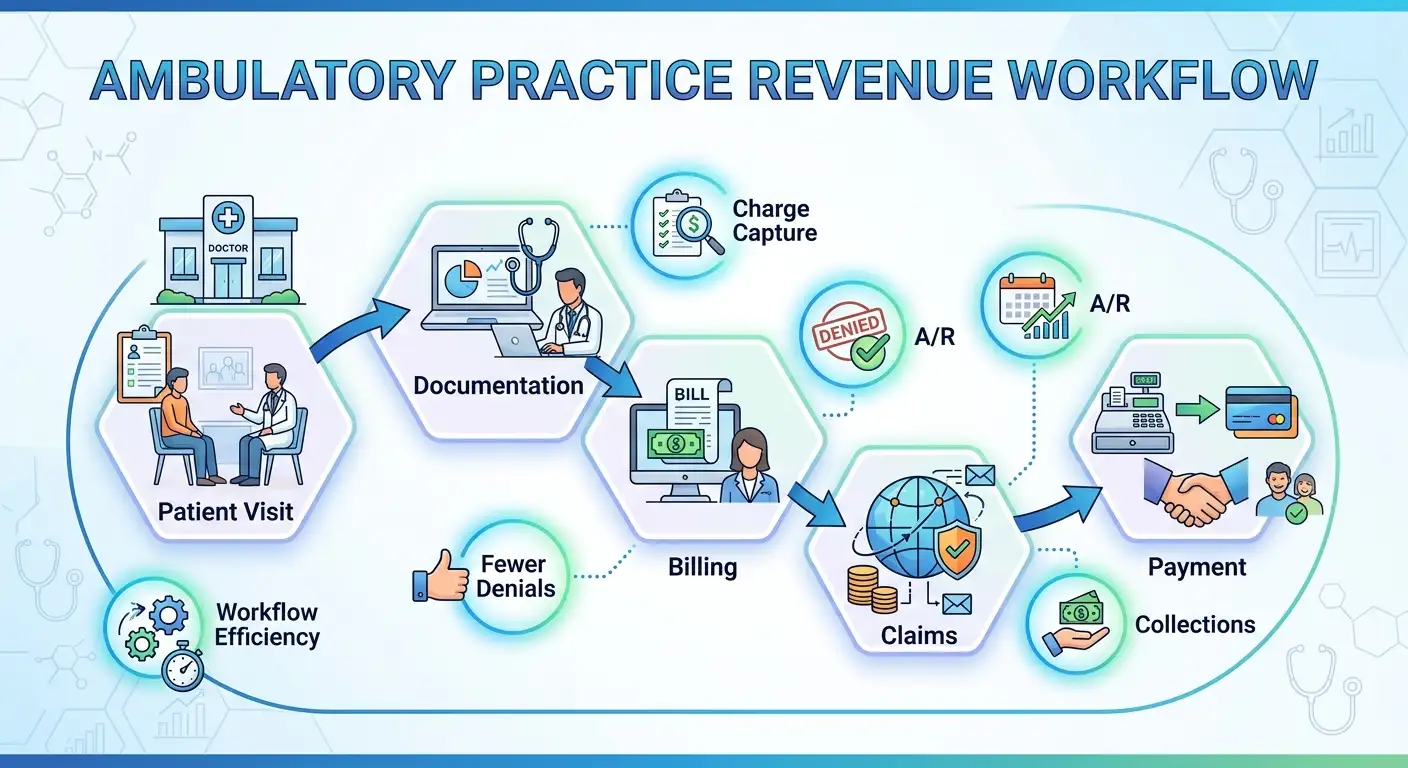

Why payer E/M downcoding happens—and how ambulatory practices can protect earned revenue.
A provider evaluates the patient. The medical decision-making is complex. The documentation supports the work performed. The appropriate E/M code is submitted.
Then, the payment arrives.
The payer has reimbursed the claim at a lower level.
For ambulatory practices, this can be frustrating. It can also be difficult to detect. In some cases, the payer may adjust the payment without changing the code submitted on the claim.
As a result, practices may lose earned revenue without realizing that payer downcoding is occurring.
The good news is that practices can take steps to identify these adjustments, strengthen documentation and coding alignment, and monitor payer payment patterns more closely.
What Is E/M Downcoding?
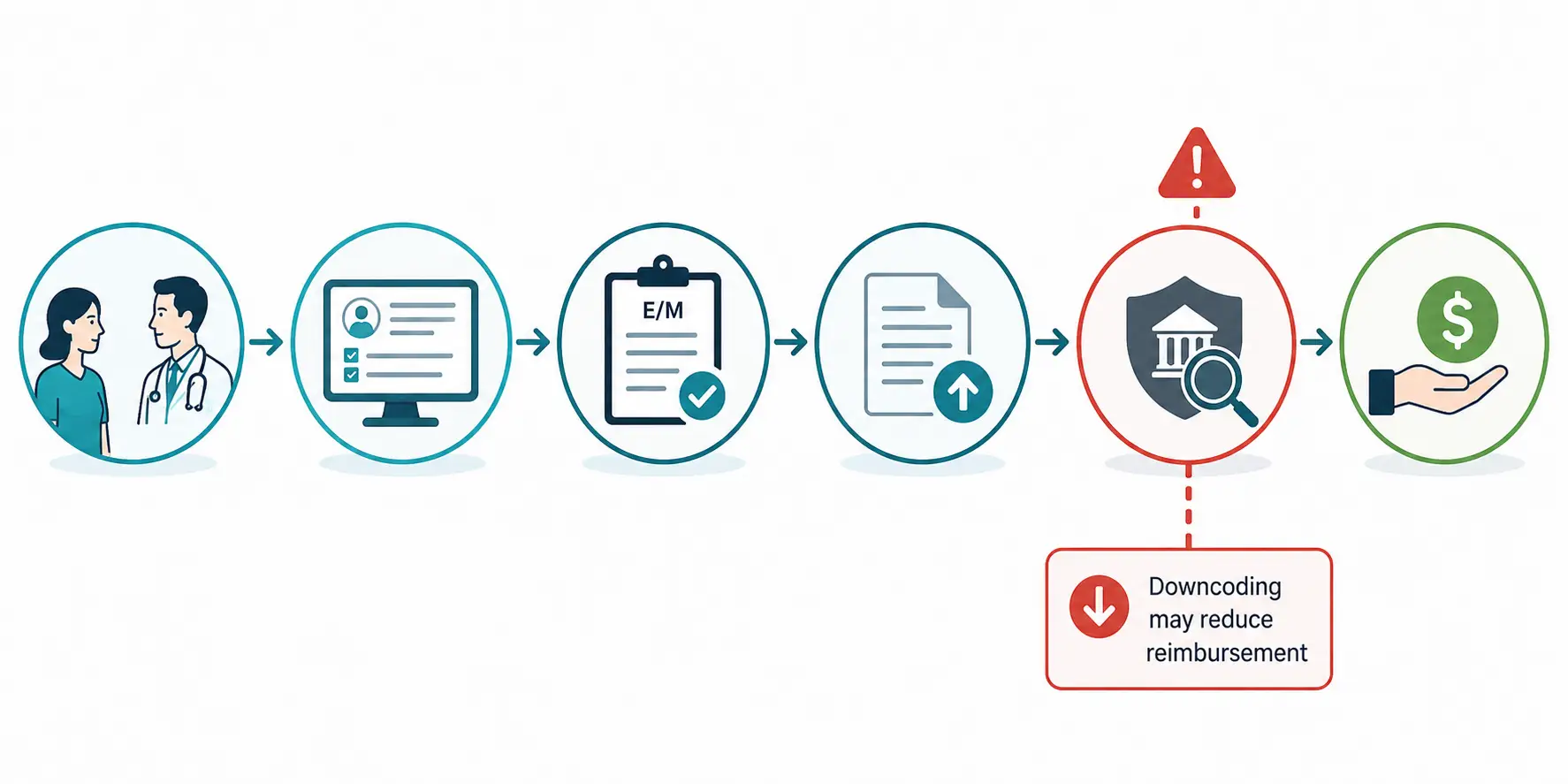
E/M downcoding occurs when a payer reduces the level of an evaluation and management service submitted by a physician or qualified healthcare professional.
For example, a practice may submit a Level 4 established patient visit. The payer may then determine that the claim supports a lower level of service and reimburse the practice accordingly.
However, the issue is not always a simple documentation mistake.
Payers may use claim edits, payment policies, software algorithms, or other review processes to evaluate E/M claims. According to the American Medical Association, some payer downcoding programs may reduce payment without reviewing the underlying medical record.
Therefore, practices need to understand both how E/M services are documented and coded and how payers are evaluating and paying those claims.
Why Might a Payer Downcode an E/M Visit?
Several factors can contribute to a payer reducing an E/M level.
Documentation may not clearly reflect medical decision-making

Current office and outpatient E/M coding allows providers to select the level of service based on medical decision-making or total time, depending on the applicable guidelines.
Medical decision-making considers:
- The number and complexity of problems addressed
- The amount and complexity of data reviewed and analyzed
- The risk of complications or morbidity associated with patient management
The AMA’s E/M revisions FAQs provide additional guidance on medical decision-making and current E/M coding requirements.
However, the medical record must clearly support the work performed.
In other words, the complexity of the visit should be evident from the documentation—not assumed by the reader.
Payer policies may not align with your internal processes
Next, payer rules and payment policies can create additional challenges.
A practice may follow current coding guidance while a payer applies its own claim-editing process. That difference can create payment reductions that are difficult to identify without reviewing remittance details and payment trends.
The AMA specifically advises practices to monitor remittance advice and payment details for signs of E/M downcoding.
Payment data may hide the problem
Finally, downcoding can be difficult to spot when teams focus only on denials.
A claim may not appear as denied. It may simply pay less than expected.
Consequently, a practice that tracks denial rates but does not compare billed services with expected reimbursement may miss a significant source of revenue leakage.
How Can Practices Help Prevent E/M Downcoding?
Preventing payer downcoding requires more than telling providers to add more information to every note.
The goal is accurate, clinically relevant documentation that clearly supports the services provided.
Make documentation support the actual work performed
First, documentation should reflect the conditions evaluated, the decisions made, and the management provided during the encounter.
Avoid unnecessary documentation that adds volume without demonstrating medical necessity.
Instead, focus on whether the record clearly communicates:
- Which problems were addressed
- What information was reviewed or analyzed
- What treatment or management decisions were made
- Why the care required the level of service reported
CMS emphasizes that documentation should support the CPT, HCPCS, and ICD-10-CM codes reported on the claim.
Practices can review the agency’s Evaluation and Management Visits guidance for additional information on documentation and payment requirements.
Review payer payment patterns

Next, practices should look beyond individual claims.
Are certain payers consistently reducing specific E/M levels? Are certain providers seeing more adjustments? Are particular remark or adjustment codes appearing repeatedly?
Regular analysis can reveal patterns that are difficult to see during daily billing operations.
For example, a practice may discover that a payer is frequently reducing Level 4 visits to Level 3 reimbursement.
That pattern deserves further review.
Use technology to improve visibility
In addition, the right EHR and practice management system can help teams connect clinical documentation, coding, claims, payments, and reporting.
When information is spread across disconnected systems, identifying revenue leakage becomes harder.
Integrated healthcare technology can help practices:
- Improve documentation workflows
- Support accurate charge capture
- Scrub claims before submission
- Track payment activity
- Monitor payer performance
- Identify recurring billing and reimbursement trends
As a result, technology becomes more than a place to store patient records. It becomes a tool for protecting financial performance.
What Should Practices Do When a Payer Downcodes a Claim?
When a practice identifies a potential downcoded claim, the first step is to understand what happened.
Review the:
- Original claim
- Medical record
- Submitted E/M code
- Remittance advice
- Payer adjustment or remark codes
- Payment received
- Applicable payer policy
Then, determine whether the documentation supports the billed service and whether the payer applied its policy appropriately.
If the claim was improperly reduced, the practice may need to pursue an appeal or dispute process.
Practices that believe a payer has improperly reduced an E/M service can also review the AMA’s resources on payer E/M downcoding programs and payment appeals.
However, individual appeals are only part of the solution.
If downcoding occurs repeatedly, practices should identify the broader pattern and determine whether workflow changes, payer monitoring, coding education, or technology improvements are needed.
Protecting Revenue Requires More Than Accurate Coding
Ultimately, E/M downcoding is not simply a coding problem. It can become a revenue cycle problem.
A practice may have knowledgeable providers and experienced billing staff. Yet, revenue can still be lost when documentation, coding, payer rules, payment data, and technology do not work together.
That is why proactive revenue cycle oversight matters.
At Virtual OfficeWare Healthcare Solutions, we help ambulatory practices evaluate the systems and processes behind their financial performance. Our Revenue Cycle Management services support claims management, denial follow-up, A/R oversight, payer performance evaluation, and billing workflow improvement.
You can also learn more about how coding errors can originate inside the systems and workflows practices use every day and how hidden revenue gaps can quietly affect practice performance.