


Your practice already has more data than it probably needs. The harder question is whether that data is helping you make better decisions.
Every day, ambulatory practices generate information through the EHR, practice management system, billing workflows, scheduling, patient engagement, and clinical documentation. Yet having access to data does not automatically make it useful.
The real opportunity is turning that information into insight.
For practice leaders, healthcare data analytics can reveal:
- Where workflows are slowing down
- Where revenue may be slipping
- Where staff time is being spent unnecessarily
More importantly, it can help leaders move from reacting to problems to identifying them earlier.
How Can Medical Practice Data Analytics Improve Decision-Making?
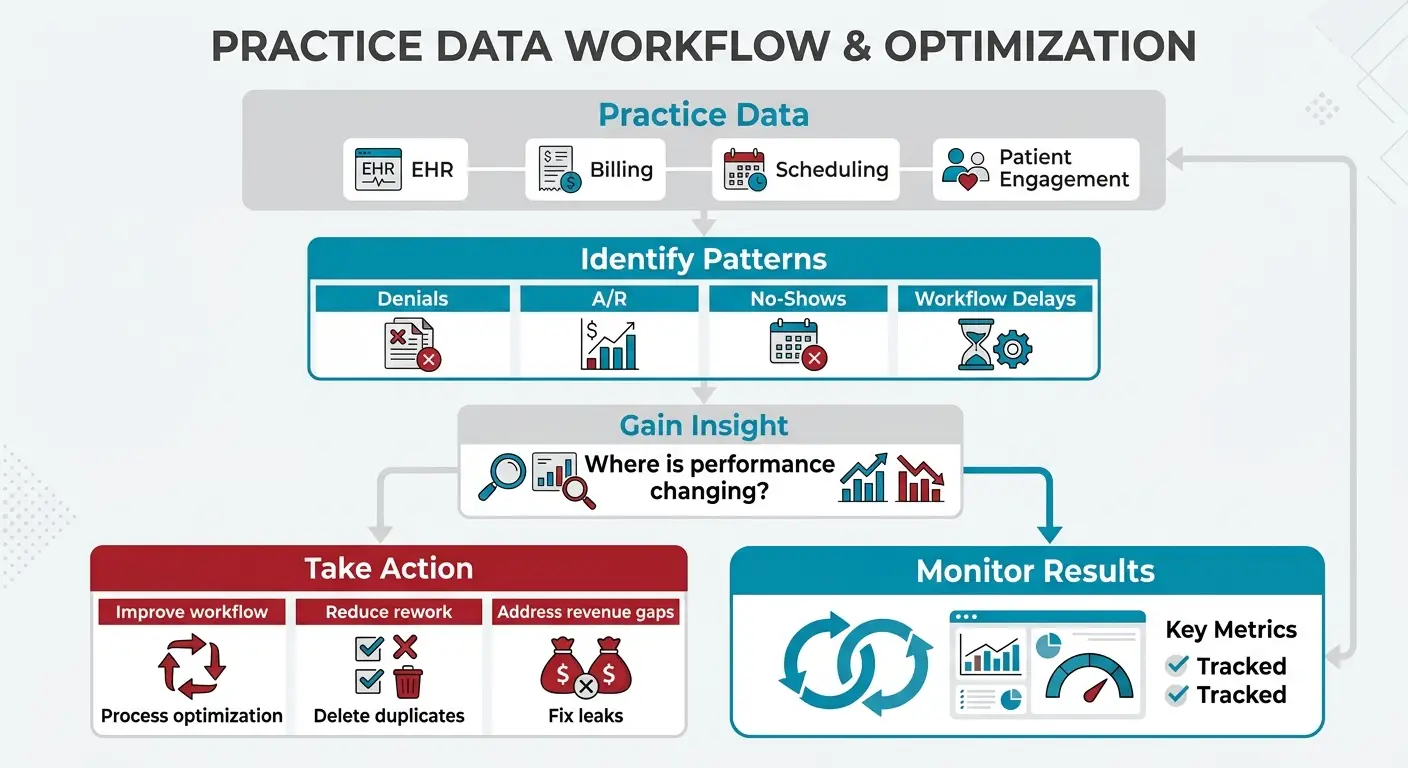
Medical practice data analytics helps leaders turn routine practice data into actionable information about financial, operational, and clinical performance.
For example, a practice may know how much it collected last month. However, that number alone does not explain why collections changed or what should happen next.
Looking at related data can provide a clearer picture.
A decrease in collections might coincide with higher denial rates, slower charge entry, growing A/R, or changes in payer behavior. Likewise, an increase in patient cancellations may point to scheduling or access issues that affect both staff productivity and revenue.
The key is to look for patterns and relationships, not isolated numbers.
Start With the Questions, Not the Dashboard
More reports do not necessarily mean better decisions. Instead, practice leaders should begin with the questions they need answered.
Consider questions such as:
- Where are we losing time in our current workflows?
- Which claims or payments are consistently delayed?
- Are certain payers producing more denials or underpayments?
- Is A/R aging concentrated in specific categories?
- Are appointment cancellations affecting particular providers or time slots?
- Which administrative tasks require the most staff intervention?
- Are clinical and financial trends pointing to the same workflow problem?
Once the question is clear, the right data becomes much easier to identify.
The Agency for Healthcare Research and Quality recommends using health IT data for quality improvement while emphasizing data accuracy, transparency, and actionable reporting.
Which Practice Data Should Leaders Be Reviewing?
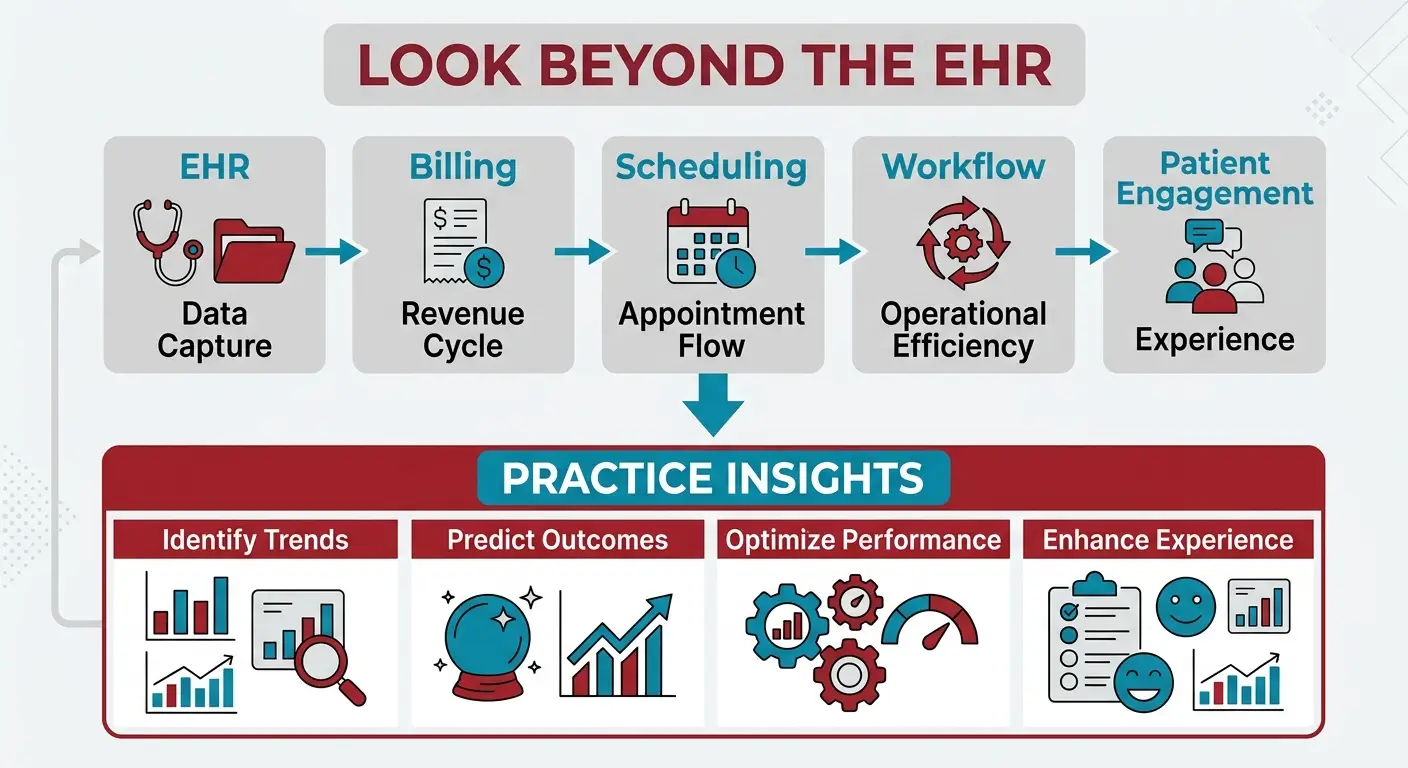
Not every metric deserves the same level of attention. The most useful data is tied directly to a decision, workflow, or business objective.
For many ambulatory practices, that means looking beyond the clinical chart.
Connect Clinical, Operational, and Financial Data
A more complete view can come from combining information across several areas:
Revenue cycle data:
Review charges, payments, denials, adjustments, A/R aging, payer performance, and collection trends.
Scheduling data:
Look at no-shows, cancellations, appointment availability, referral patterns, and provider utilization.
Workflow data:
Identify bottlenecks such as delayed charge entry, incomplete documentation, manual claim corrections, or repetitive staff tasks.
Clinical data:
Depending on the practice and reporting capabilities, examine trends related to preventive care, chronic disease management, quality measures, or patient follow-up.
Patient engagement data:
Portal activity, appointment responses, reminders, and other engagement measures can provide insight into access and communication workflows.
For example, a practice might discover that a particular payer consistently produces more rework. That finding could prompt a review of eligibility verification, authorization requirements, coding, documentation, or claim submission processes.
In other words, the report is not the solution. The decision that follows the report is.
VOW’s guide on medical billing reports every physician practice should review provides a practical starting point for identifying financial reports that can reveal potential billing and revenue gaps.
What Makes Healthcare Data Useful?

Good analytics depends on more than having sophisticated software. Data needs to be accurate, consistent, accessible, and connected to a clear business purpose.
The Office of the National Coordinator for Health Information Technology emphasizes that data quality supports effective operations, decision-making, and analytics. Its guidance also stresses assessing data quality against the purpose for which the data will be used.
Avoid the “More Data, More Problems” Trap
One common challenge is report overload.
Staff may receive dozens of dashboards and reports without knowing which ones require action. Consequently, important trends can get buried among information that has little immediate value.
A better approach is to establish a small group of meaningful measures.
For example, a practice might review the following each month:
- A/R aging and trends
- Denial patterns by payer and reason
- Charge-to-claim turnaround
- Payment and adjustment trends
- No-show and cancellation activity
- Provider or location-level performance
- High-volume workflow bottlenecks
Then, assign responsibility for reviewing each measure.
The AMA similarly recommends monitoring revenue cycle key performance indicators so practices can identify issues and respond more quickly.
This creates a simple cycle: measure → identify → investigate → act → monitor.
What Should Ambulatory Practices Do Next?
You do not need a major analytics initiative to start making better use of your data. Instead, begin with a focused review of the information your practice already has.
Consider these steps:
- Choose three to five business questions your leadership team needs answered.
- Identify the reports that can help answer those questions.
- Check data quality before acting on trends or comparisons.
- Look for patterns, rather than reacting to one unusual month.
- Connect financial findings to workflows that may be creating the problem.
- Assign accountability for reviewing important metrics.
- Set a regular review schedule so analytics becomes part of practice management.
- Turn findings into specific actions, then monitor whether those actions improve results.
Most importantly, do not assume your EHR or practice management system is automatically delivering meaningful insight simply because it contains the data.
Technology matters. However, knowing what to look for—and what to do with what you find—matters just as much.
For practices looking more broadly at financial performance, VOW’s recent guidance on strengthening revenue cycle management operations explores how reporting, workflow visibility, automation, and experienced oversight can work together.