

Medicare reimbursement changes can create pressure across an ambulatory practice. Even a modest payment reduction may affect financial planning when labor, technology, supplies, and administrative costs continue to rise.
Centers for Medicare & Medicaid (CMS) has proposed separate 2027 Physician Fee Schedule conversion factors for qualifying and nonqualifying Alternative Payment Model participants. Under the proposal, the nonqualifying APM conversion factor would decrease by 1.68% from the current 2026 rate. The qualifying APM conversion factor would decrease by 1.19%. These figures remain proposed and may change when CMS publishes the final rule.
However, the larger concern for many independent practices is not one percentage alone. It is how lower reimbursement may compound existing challenges, including denials, delayed claims, underpayments, aging A/R, and rising operating expenses.
As Medicare reimbursement tightens, practices may need greater visibility into every stage of the revenue cycle. The goal is not simply to work harder. Instead, it is to identify preventable revenue loss and improve the processes that support accurate, timely payment.
Why Does Medicare Reimbursement Matter to Practice Operations?
Medicare reimbursement affects more than the amount paid for an individual service. Over time, payment changes may influence practice margins, staffing plans, technology investments, and long-term growth decisions.
For practices with a significant Medicare patient population, even a small reduction may become more noticeable across thousands of visits. Meanwhile, many operating expenses do not decline when reimbursement does.
Therefore, practice leaders should evaluate the full financial picture rather than focusing only on the proposed conversion factor.
The American Medical Association (AMA) provides additional insight into physician payment policy and the financial pressures affecting medical practices. Reviewing these resources can help practice leaders understand broader reimbursement trends while evaluating their own revenue-cycle performance.
A reimbursement reduction can expose existing revenue gaps
A strong revenue cycle cannot change Medicare payment policy. It can, however, help a practice collect the reimbursement it has earned more efficiently.
For example, a claim that is denied, delayed, or underpaid may create additional financial pressure when margins are already tight. Small workflow gaps can also accumulate across multiple providers, locations, or service lines.
Practice leaders may want to review:
- Clean-claim performance
- First-pass claim acceptance
- Common denial and rejection reasons
- Charge-entry turnaround times
- Aging A/R by payer and balance category
- Recurring underpayments
- Claims held in work queues
- Timeliness and consistency of follow-up
These measures can reveal whether revenue is being delayed or lost after care has already been delivered.
CMS provides additional information about the Medicare Physician Fee Schedule and current payment policies through its Physician Fee Schedule resources. Practices should continue monitoring CMS updates because the 2027 proposal is not yet final.
Where Can Ambulatory Practices Protect Revenue?
When reimbursement declines, increasing patient volume may not be the most practical—or sustainable—response. Instead, many practices may benefit from improving the efficiency and reliability of existing workflows.
The most effective opportunities often involve reducing preventable rework and improving visibility into claims after submission.
Focus on revenue capture before and after claim submission
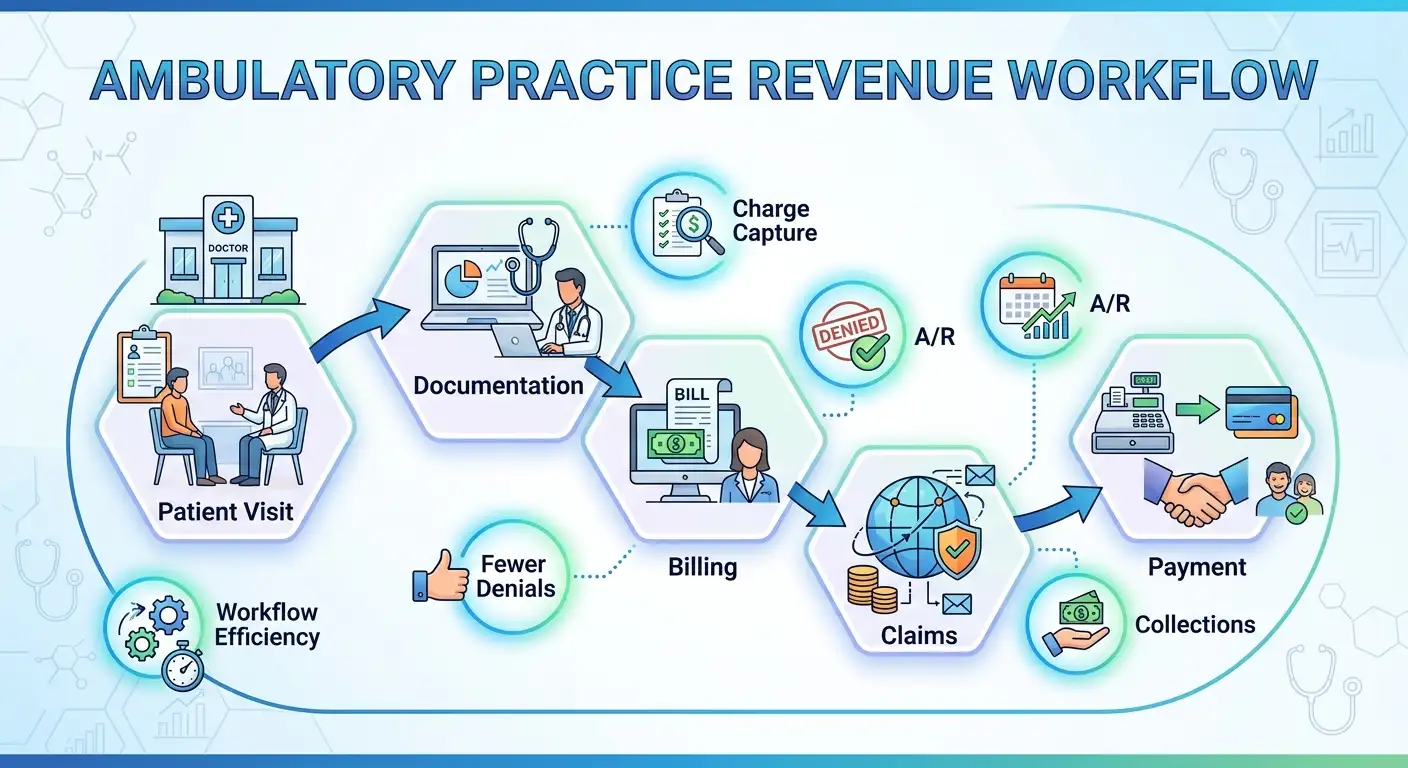
Revenue protection begins before a claim reaches the payer. Accurate patient information, eligibility verification, documentation, coding, charge capture, and claim edits all contribute to cleaner submissions.
However, the work does not end when a claim is transmitted.
Practices should also monitor payer responses, identify recurring denial patterns, and review whether paid amounts align with expected reimbursement. A claim marked as paid is not always a claim paid correctly.
For example, recurring underpayments may be difficult to identify when staff rely on manual review or lack clear reporting. Likewise, unresolved claims may remain in A/R when work queues are not reviewed consistently.
Healthcare technology can help organize these activities. Practice management and billing systems may support automated claim edits, worklists, reporting, denial tracking, and follow-up prioritization. Still, technology is most effective when paired with clear processes and knowledgeable oversight.
VOW’s healthcare revenue cycle management services are designed to help physician practices improve billing visibility, address revenue-cycle challenges, and support more consistent follow-up.
How Can Practice Leaders Strengthen Revenue Cycle Performance?

A proactive review can help practices identify risks before reimbursement pressure becomes more difficult to absorb.
Rather than reviewing financial performance only at year-end, leaders may benefit from establishing regular revenue-cycle checkpoints.
Use performance data to guide improvement
A useful review should move beyond total collections. Practice leaders should ask—
what is driving performance and where improvement is possible?
Consider these questions:
- Which denial reasons occur most often?
- Are certain payers, providers, or service lines creating recurring issues?
- How quickly are charges entered and claims submitted?
- Which claims are aging beyond expected timeframes?
- Are underpayments being identified and addressed?
- Do billing work queues have clear ownership?
- Are staff spending time on repetitive tasks that technology could streamline?
- Has the practice’s A/R performance changed over time?
These questions can help separate isolated issues from recurring workflow problems.
In addition, practices should review performance trends regularly. A single monthly result may not explain the full picture. Trends can reveal whether denials are increasing, follow-up is slowing, or specific payers require closer attention.
For additional guidance, VOW’s resource on year-end medical practice reviews and revenue-cycle performance outlines several areas practices can assess, including aged A/R, denial patterns, underpayments, coding, and patient-balance workflows.
What Should Ambulatory Practices Do Next?
The proposed 2027 Medicare payment changes provide an opportunity to evaluate revenue-cycle readiness before new rates take effect.
Practice leaders do not need to overhaul every process at once. Instead, they can begin by identifying the areas with the greatest financial or operational impact.
Consider these next steps:
- Review Medicare revenue by provider, specialty, and service line.
- Estimate how proposed payment changes could affect annual revenue.
- Analyze denial trends and recurring claim-edit issues.
- Review aging A/R by payer and balance category.
- Identify underpayments that may be going unnoticed.
- Evaluate charge-entry and claim-submission timelines.
- Review billing work queues and assign clear accountability.
- Assess whether current technology supports timely reporting and follow-up.
- Establish regular revenue-cycle performance reviews.
- Consider an independent A/R assessment to identify hidden risks.
Most importantly, avoid treating lower reimbursement as only a payment issue. It is also an operational issue.
A practice with strong revenue-cycle visibility may be better positioned to identify preventable delays, reduce unnecessary rework, and protect earned revenue. In contrast, unresolved workflow gaps can become more costly when reimbursement and margins are under greater pressure.
Is Your Revenue Cycle Ready for Tighter Reimbursement?

Medicare payment policy may be outside your practice’s control. However, the efficiency, visibility, and consistency of your revenue cycle are areas where meaningful improvements may be possible.
VOW’s Complimentary A/R Analysis and Revenue Cycle Health Check can help your practice evaluate aging A/R, denial trends, claim follow-up, and potential revenue gaps. Connect with Virtual OfficeWare Healthcare Solutions to discuss your current workflows and explore practical opportunities to strengthen revenue-cycle performance.