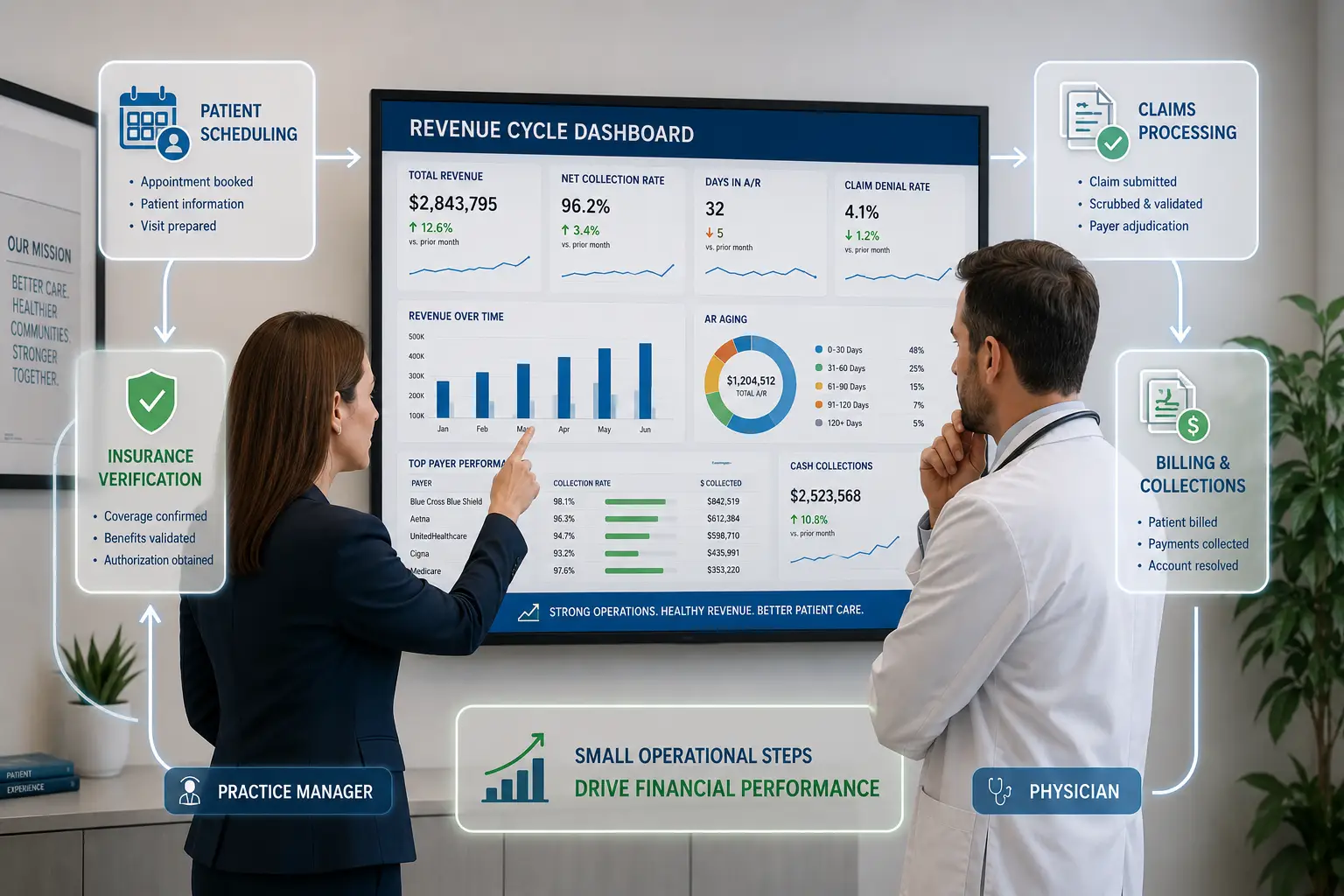


Healthcare Teams Are Overwhelmed by Administrative Work
Healthcare providers face constant pressure to do more with less. Staff shortages, growing patient demands, claim denials, and documentation burdens continue to slow practices down.
At the same time, healthcare organizations are hearing more about Artificial Intelligence (AI). However, many leaders still ask an important question:
What Is the Difference Between Generative AI and Agentic AI in Healthcare?
Although both technologies use AI, they serve different purposes. More importantly, understanding the difference can help practices improve efficiency, reduce burnout, and strengthen financial performance.
As healthcare technology evolves, practices need solutions that support both patient care and operational performance. That is where modern AI-driven healthcare solutions are making a major impact.
What Is Generative AI in Healthcare?
Generative AI Creates Content and Responses
Generative AI focuses on creating information. It can generate text, summaries, recommendations, and patient communication based on prompts or data inputs.
For example, Generative AI can help healthcare organizations:
- Draft clinical notes
- Create patient summaries
- Generate appointment reminders
- Write prior authorization letters
- Produce billing documentation
- Assist with patient communication
Organizations like OpenAI and Microsoft, alongside healthcare technology vendors such as CureMD and AdvancedMD, continue advancing AI-driven capabilities across healthcare environments.
What Should Healthcare Practices Expect From Generative AI?
Generative AI improves speed and reduces repetitive work. As a result, providers spend less time typing and more time focusing on patients.
However, Generative AI still requires human review. It supports decision-making, but it does not independently take action across systems.
In other words, it helps create. It does not fully execute workflows.
What Is Agentic AI in Healthcare?
Agentic AI Goes Beyond Content Creation
Agentic AI takes automation a step further. Instead of only generating information, it can perform tasks, make decisions, and complete workflows with limited human involvement.
For example, Agentic AI may:
- Follow up on unpaid insurance claims
- Monitor claim denials automatically
- Schedule patient appointments
- Trigger billing workflows
- Escalate unresolved A/R issues
- Coordinate tasks between systems
Unlike Generative AI, Agentic AI acts more like a digital team member.
Consequently, healthcare organizations gain faster workflows, fewer manual touchpoints, and stronger operational efficiency.
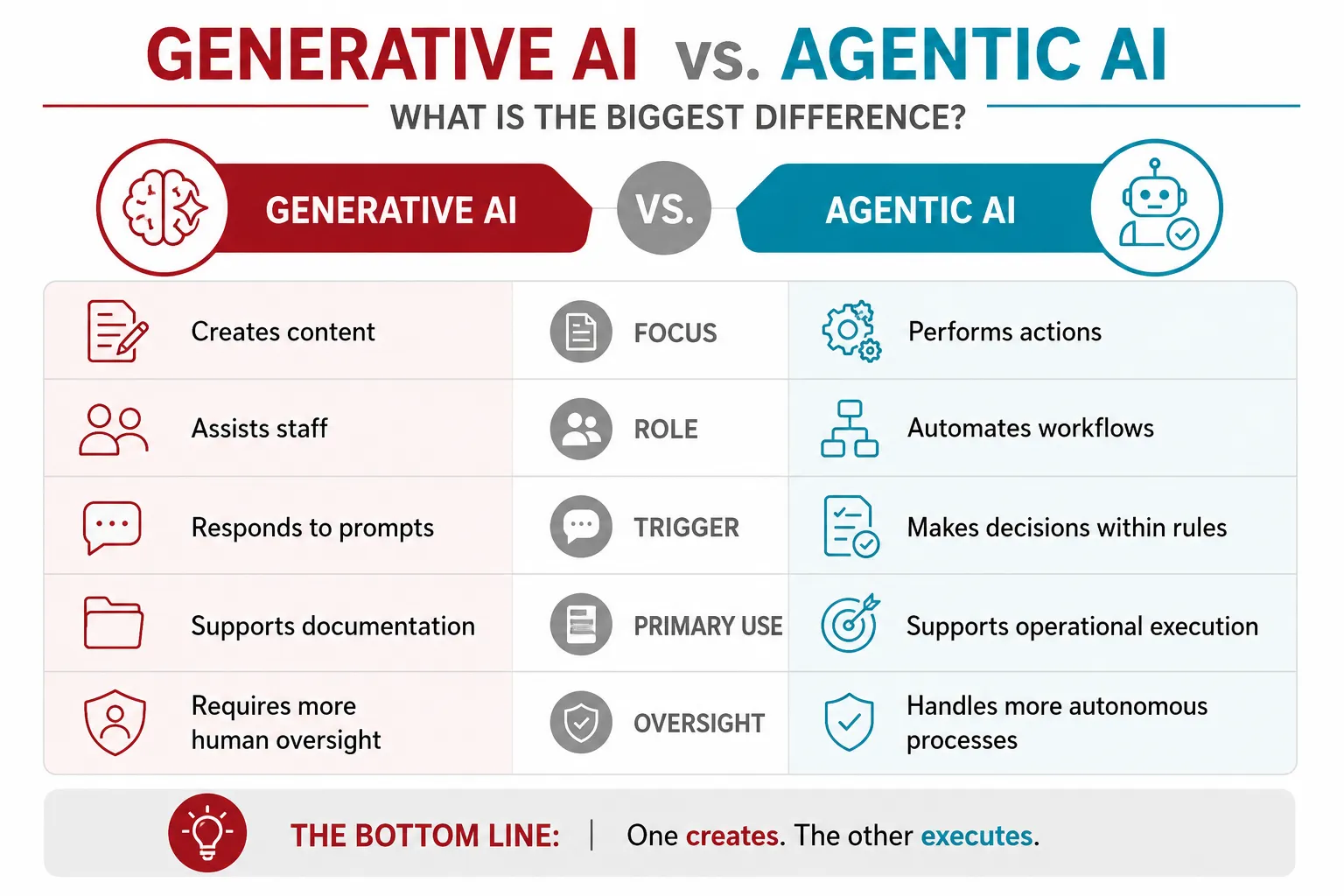
Generative AI vs. Agentic AI: What Is the Biggest Difference?
One Creates. The Other Executes.
Generative AI focuses on producing content. Agentic AI focuses on taking action.
Here is a simple breakdown:
Generative AI | Agentic AI |
Creates content | Performs actions |
Assists staff | Automates workflows |
Responds to prompts | Makes decisions within rules |
Supports documentation | Supports operational execution |
Requires more human oversight | Handles more autonomous processes |
Therefore, many healthcare organizations will likely use both technologies together.
Why Does This Matter for Healthcare Practices?
Administrative Burnout Continues to Rise
Many healthcare teams still rely on manual billing processes, disconnected systems, and time-consuming administrative tasks.
As a result, practices often experience:
- Delayed reimbursements
- Higher claim denial rates
- Staff burnout
- Slower patient communication
- Increased operational costs
Meanwhile, patients expect faster and more personalized experiences.
Because of these growing pressures, healthcare organizations need smarter operational support.
How AI-Powered Healthcare Solutions Improve Revenue Cycle Management
AI Can Help Reduce Financial Bottlenecks
AI-driven Revenue Cycle Management (RCM) solutions can improve billing accuracy, streamline workflows, and accelerate reimbursements.
For example, AI can help practices:
- Identify billing inefficiencies earlier
- Reduce denied claims
- Improve accounts receivable follow-up
- Enhance reporting visibility
- Automate repetitive administrative tasks
Additionally, AI-powered systems help staff focus on higher-value work instead of repetitive manual processes.
According to Healthcare IT News, AI adoption continues growing because healthcare organizations want stronger operational efficiency and improved patient experiences.
How Virtual OfficeWare Supports AI-Driven Healthcare Operations

Smarter Healthcare Technology Starts With the Right Partner
Virtual OfficeWare Healthcare Solutions helps physician practices improve operational efficiency with AI-powered healthcare technology and Revenue Cycle Management services.
Their solutions help practices:
- Streamline billing workflows
- Improve reimbursement timelines
- Reduce administrative burdens
- Optimize practice management systems
- Support better patient engagement
Additionally, Virtual OfficeWare Revenue Cycle Management Services provide tailored support designed to improve financial performance and reduce billing complexity.
As healthcare AI continues evolving, practices need practical solutions that support both people and performance.
What Should Healthcare Organizations Expect Next?
AI Will Continue Expanding Across Healthcare
Healthcare AI is still evolving rapidly. However, one thing is already clear.
Generative AI will continue helping providers create and communicate faster. Meanwhile, Agentic AI will increasingly automate operational workflows behind the scenes.
Together, these technologies may help healthcare organizations:
- Improve patient experiences
- Strengthen operational efficiency
- Reduce staff burnout
- Accelerate revenue collection
- Improve decision-making
Therefore, practices that begin preparing now may gain a significant advantage moving forward.
Ready to Explore Smarter Healthcare Technology?

AI-driven healthcare solutions are no longer a future concept. They are becoming essential tools for improving practice efficiency and financial health.
Schedule a personalized consultation or software demo with Virtual OfficeWare to learn how AI-powered healthcare technology and Revenue Cycle Management solutions can support your practice goals.